Team 48
Clawback
Clawback is an AI agent that gets your money back after you buy, but only inside a Pact you signed: the AI proposes, a fixed rule gate decides, and every decision is signed and cites the store's own policy.
Community votes recognize the build and do not affect official judging.
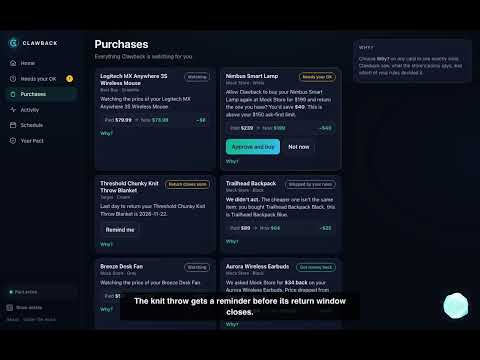
Review the project
Start with the source code, then open the demo or video if available.
Tools used
 Senso.ai
Event resource · Docs
Sign in to visit Amplitude + Statsig
Event resource · Get started with Amplitude
Sign in to visit SingleStore
Event resource · Get started with SingleStore
Sign in to visit Persona
Event resource · Help center
Sign in to visit Airbyte
Event resource · Airbyte Context docs
Sign in to visit