tokens&
BrowseFor enterprises
tokens&

Find tools, check provider offers, save a build plan, and share your work when you’re ready.

For buildersFor enterprises

For builders

  • Startup credits and perks
  • Agent Skills
  • Publish a project

For enterprises

  • Start free company workspace
  • Submit a tool, product, or perk

Community

  • Community
  • Newsletter
  • Events
Xin

© 2026 tokensand, LLC. All rights reserved.

  • Terms
  • Privacy
  • Security
  • Data Processing
  • Status
  1. Hackathon
  2. Project gallery
  3. Haystack
Awab Ibrahimabout 10 hours agoContributorJudging locked: Event build

Haystack

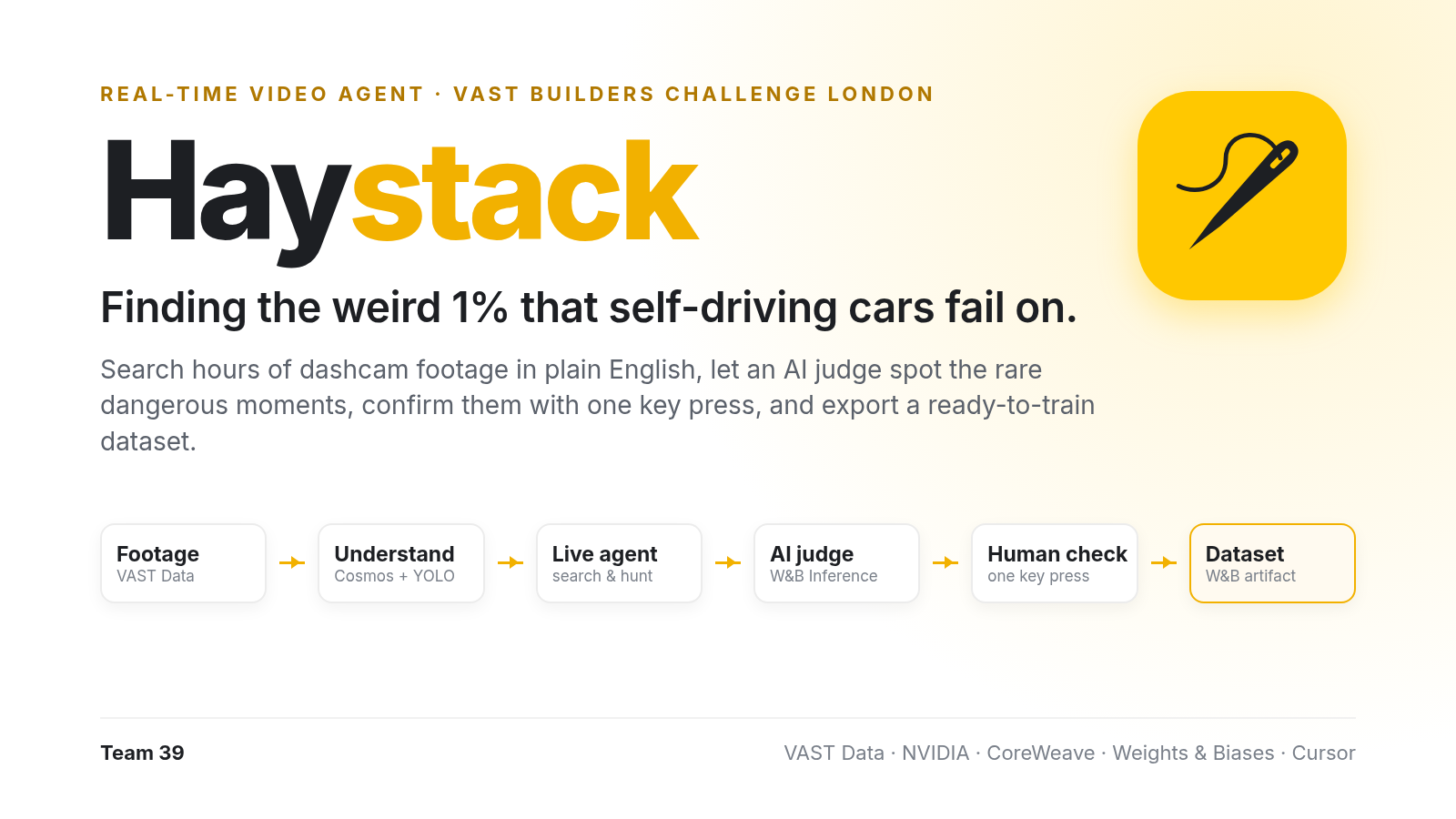
Haystack is a real-time video agent that hunts through hours of dashcam footage for the rare, dangerous moments self-driving cars fail on, lets a human confirm them, and exports them as a ready-to-train dataset for autonomous-vehicle teams.

Review the project

Start with the source code, then open the demo or video if available.

Tools used
  • VAST Data logoVAST Data
  • SpaceXAI (Cursor) logoSpaceXAI (Cursor)
  • CoreWeave (Weights & Biases) logoCoreWeave (Weights & Biases)
  • NVIDIA logoNVIDIA
View GitHub repository
Visit project websiteWatch demo videoProject gallery
Demo video
Watch demo video
Project description
Self-driving cars don't crash on the boring 99% of driving. They crash on the weird 1%: a pedestrian hidden by a turning bus, a horse-drawn carriage, a school bus with its stop sign out. Those moments are buried in hours of normal footage and finding them by hand is slow and expensive. Haystack finds them for you. How it works: 1. Understand: dashcam video is stored on VAST Data (S3 + VastDB). NVIDIA's VSS Blueprint uses Cosmos-Reason2 to describe every 5-second clip and Cosmos-Embed1 to make it searchable. YOLO11 boxes people and vehicles and measures motion. 2. Search: type a plain-English question ("cyclist running a red light") or switch on the Live agent, which scans camera by camera, invents new hunts and flags edge cases as it finds them. 3. Judge: an LLM on Weights & Biases Inference scores each clip for rarity, danger and training value and explains why. Every call is traced in W&B Weave. 4. Human check: one key press (Y/N) confirms or rejects each find. This measures the judge's accuracy, and rejected clips never reach the dataset. 5. Act: export a labelled dataset (clips, boxes, COCO labels, train/val split) logged as a versioned W&B artifact. Built in Cursor, running on CoreWeave GPUs.

Project links
  • GitHub repository
  • Project website
  • Demo video
Tools used
  • VAST Data logoVAST Data
  • SpaceXAI (Cursor) logoSpaceXAI (Cursor)
  • CoreWeave (Weights & Biases) logoCoreWeave (Weights & Biases)
  • NVIDIA logoNVIDIA