Team 62

KinCheck

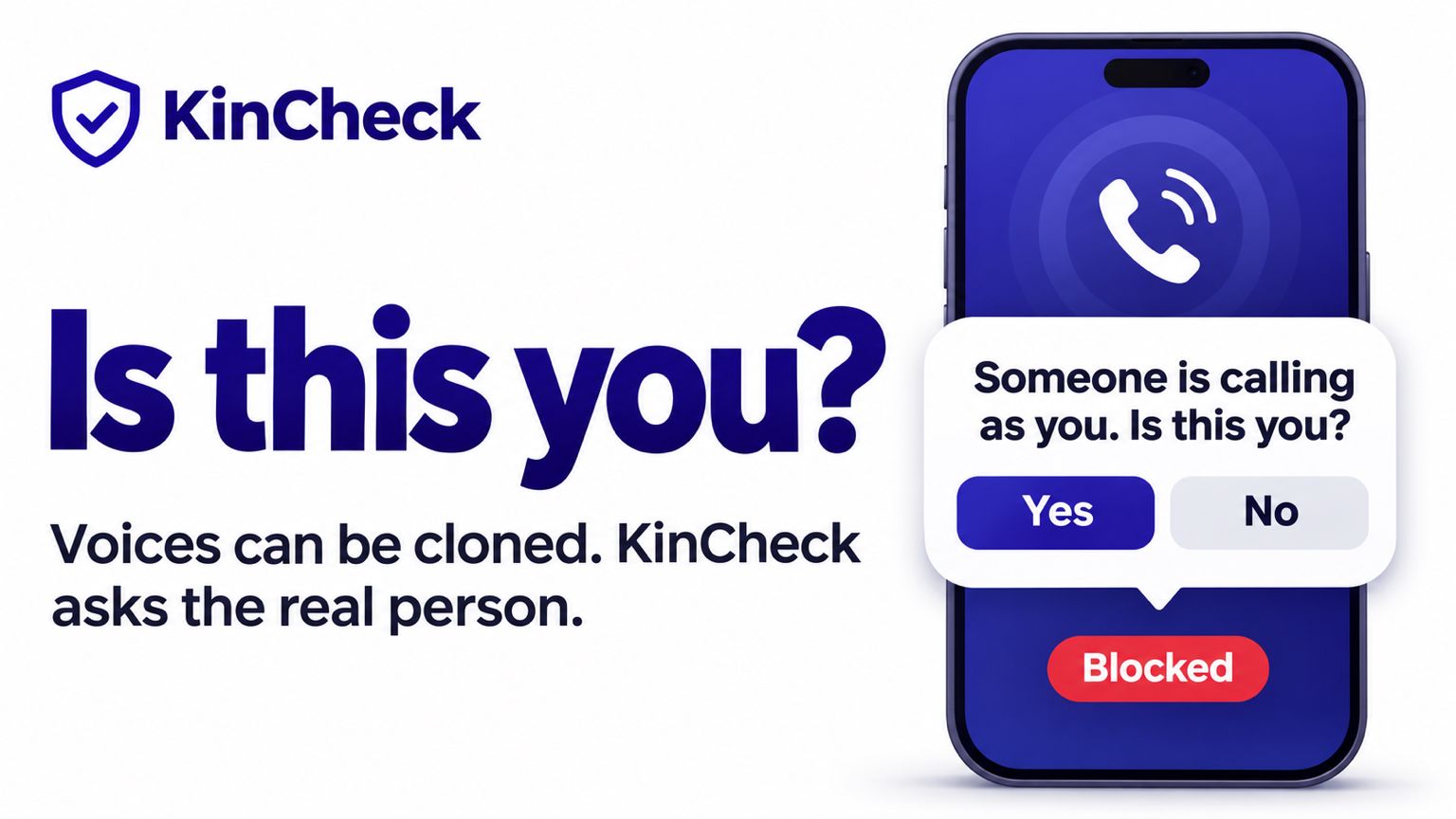
A personal phone agent that beats voice-clone scams: when a caller claims to be someone you trust and asks for money, it holds the call and asks that real person on their own phone, "Is this you?", before anything happens.

Check your own project

Community votes recognize the build and do not affect official judging.
Review the project

Start with the source code, then open the demo or video if available.

View GitHub repository
Project description
A cloned voice can sound like your son, your boss or your best friend. KinCheck never judges the voice: it asks the real person. Live call. A Vapi agent answers and transcribes with name-boosted Deepgram nova-3. Superlinked's serverless inference (GLiNER) catches the identity claim, money, urgency and secrecy in ~150 ms. Cognee's knowledge graph turns "your teammate from the hackathon" into a real contact. KinCheck asks that person "Is this you?" on their own channels at once: WhatsApp via Beeper and Telegram. One decision. SingleStore holds every call: one atomic update lets exactly one answer win. No ends the call, Yes forwards it, and every step is audited. SingleStore vector search over Superlinked bge-m3 embeddings names known scam scripts. Trust and setup. Persona checks identity at sign-up (hosted flow, sandbox). The app manages trusted contacts, the Cognee memory graph and expected calls from a mailbox scan (sample): a real courier passes, a fake fee is blocked. A consented cloned-voice call is proven end to end. Measured. On our 34-caller drill set, rules flagged 16 of 18 impersonations with 1 of 12 false alarms; after the fix, 18 of 18 and 0 of 12. A real Firedrill run of 3 hard callers held both scams and wrongly challenged one genuine caller: the false alarm we then fixed. Amplitude Agent Analytics records each call with four rule evals: never offered a name, never agreed to pay, only verified actions, asked the real person. The model talks; only code acts.
Tools used