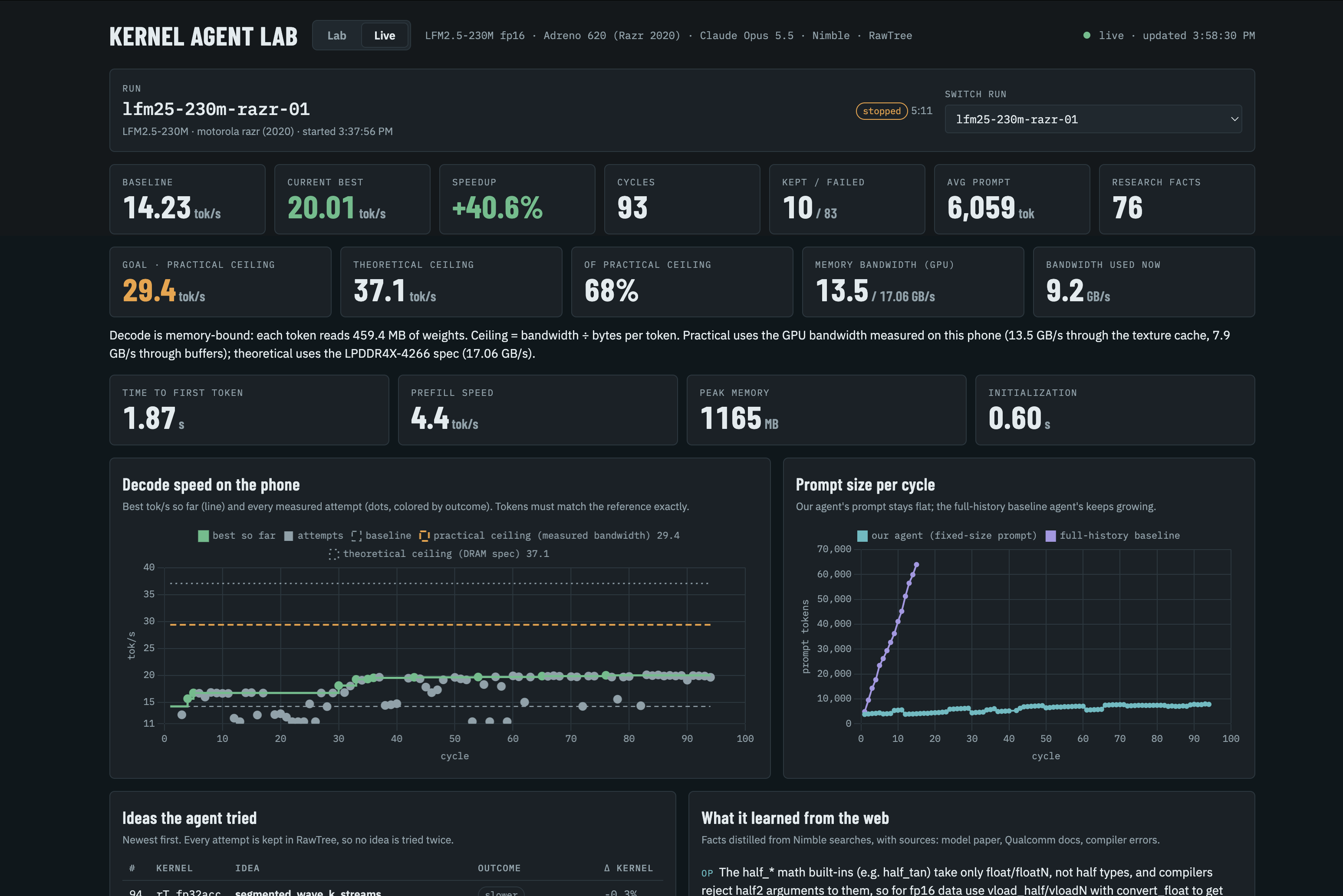
What it does: Livik profiles an LLM running on an Android phone, finds the slowest GPU kernels, and rewrites them one attempt at a time. Every attempt runs the full model on the device and must produce exactly the same tokens; only faster kernels are kept. On a 2020 Motorola Razr, Liquid AI's LFM2.5-230M went from 14.2 to 20.0 tok/s (+41%), 68% of the device's measured memory-bandwidth ceiling, beating the stock int8 engine at full fp16 precision.
Long horizon without drowning in history: each cycle is stateless. The prompt is rebuilt from memory at a fixed ~6k tokens after 90+ cycles, while a full-history agent hit 64k tokens in 15. Kill it anytime; it resumes where it left off.
RawTree (Tinybird): every worker call, device run, idea, kernel diff, research fact and benchmark is an event in RawTree. The agent reads its tried ideas, facts and best kernels back with SQL each cycle, which powers resume and warm start: LFM2.5-350M, never optimized before, jumped from 12.4 to 15.6 tok/s in under 2 minutes with zero LLM calls by reusing 230M's winners.
Nimble: when the device's compiler rejects a kernel, the agent searches the web on its own (model paper, Qualcomm Adreno docs, the exact error) and stores distilled facts with sources.
Liquid AI: LFM2.5-230M, 350M and VL-450M are the models. Claude Opus 5.5 on Vertex AI writes the kernels. The Lab web app runs, benchmarks and streams device logs.