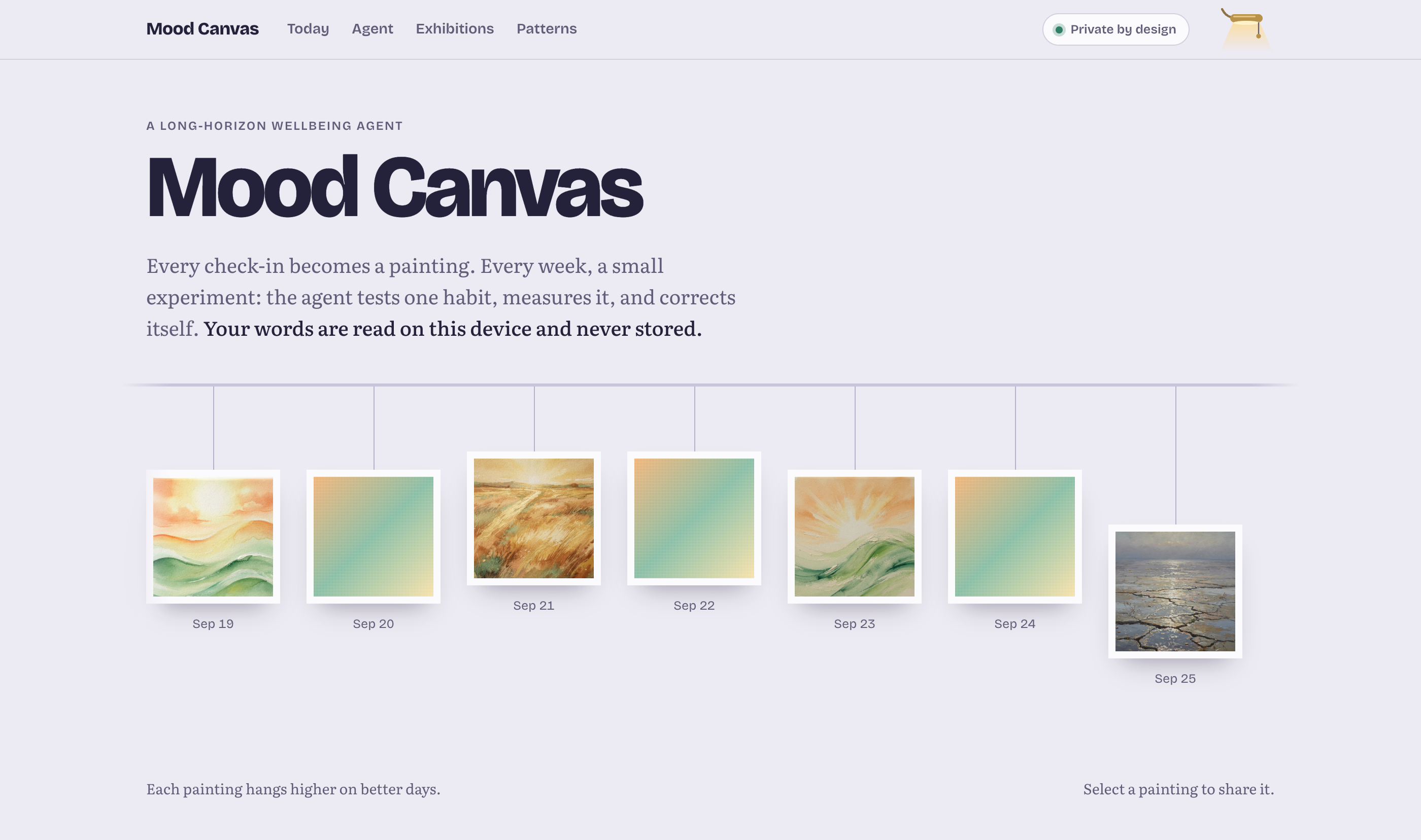
Journaling helps, but nobody rereads their journal. Mood Canvas does it for you, over weeks, as a long-horizon agent.
Each check-in (typed or spoken) becomes signals and an abstract painting. Once a week the agent runs one cycle: observe (compare the experiment week with a baseline), correct (a reproducible rule marks the idea supported, rejected, too hard, or needing more data), plan (rank untested causes like sleep, work stress, movement and social contact), and act (start a 7-day habit with one daily question). In our demo it rejects work stress when mood doesn't move, then confirms sleep at +1.4 mood.
It never re-reads its history. Its only context is a memory card of about 360 tokens after six weeks. Journal text is discarded after extraction, so the privacy rule and the memory design are the same thing.
Liquid AI: LFM2-2.6B runs locally and is the only model that sees your words, with schema-constrained JSON (0 failures in 18 tests). LFM2.5-Audio transcribes voice on-device. LFM2 also breaks near-ties in the agent's plan.
Tinybird: stores signals only; the agent reasons from the window_stats and driver_scan endpoints and logs every step.
Nimble: finds sources from 9 trusted health sites for each experiment, from a single topic word.
Black Forest Labs: flux-2-pro paints each day from an abstract scene and merges each week's paintings into one shareable panorama.
Crisis language shows 988 resources, skips the painting, and pauses experiments.