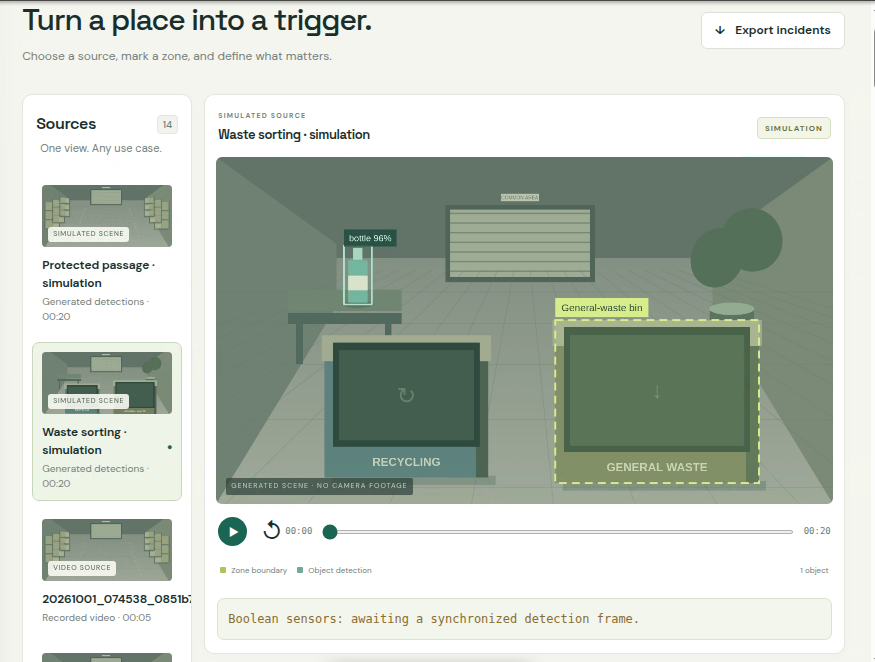
Traditional computer vision systems can identify objects but understanding when their presence is relevant often requires some custom programming for each application. Occlusive Logic bridges that gap by allowing users to turn existing video detections into configurable, actionable rules. Users select a video source, draw a polygonal zone directly over the footage, choose the object classes, and configure confitions such as entering an area, remaining there for a specified duration, or being absent. A custom Python rules engine evaluates the object positions, confidence thresholds, the tracking informations and temporal conditions to determine when a rule has been satisfied.
When triggered, the system creates a time stamped incident ticket with visual evidence. Users can inspect, revisit, and resolve incidents through a web dashboard.
The application integrates with VAST's video infrastructure and uses YOLO detection metadata from VAST provided footage. It is built with Python, FastAPI, Javascript, SQLite, and a custom geometry and temporal state engine. Additional simulations demonstrate potential applications in accessibility focused occlusion monitoring and in proper waste management.
Computer Engineering foundation: Occlusive logic treats camera detections as virtual sensor signals and applies programmable spatial and sequential logic to produce an event. This lays a foundation for future boolean rule composition and edge hardware deployment.

 SpaceXAI (Cursor)
 NVIDIA