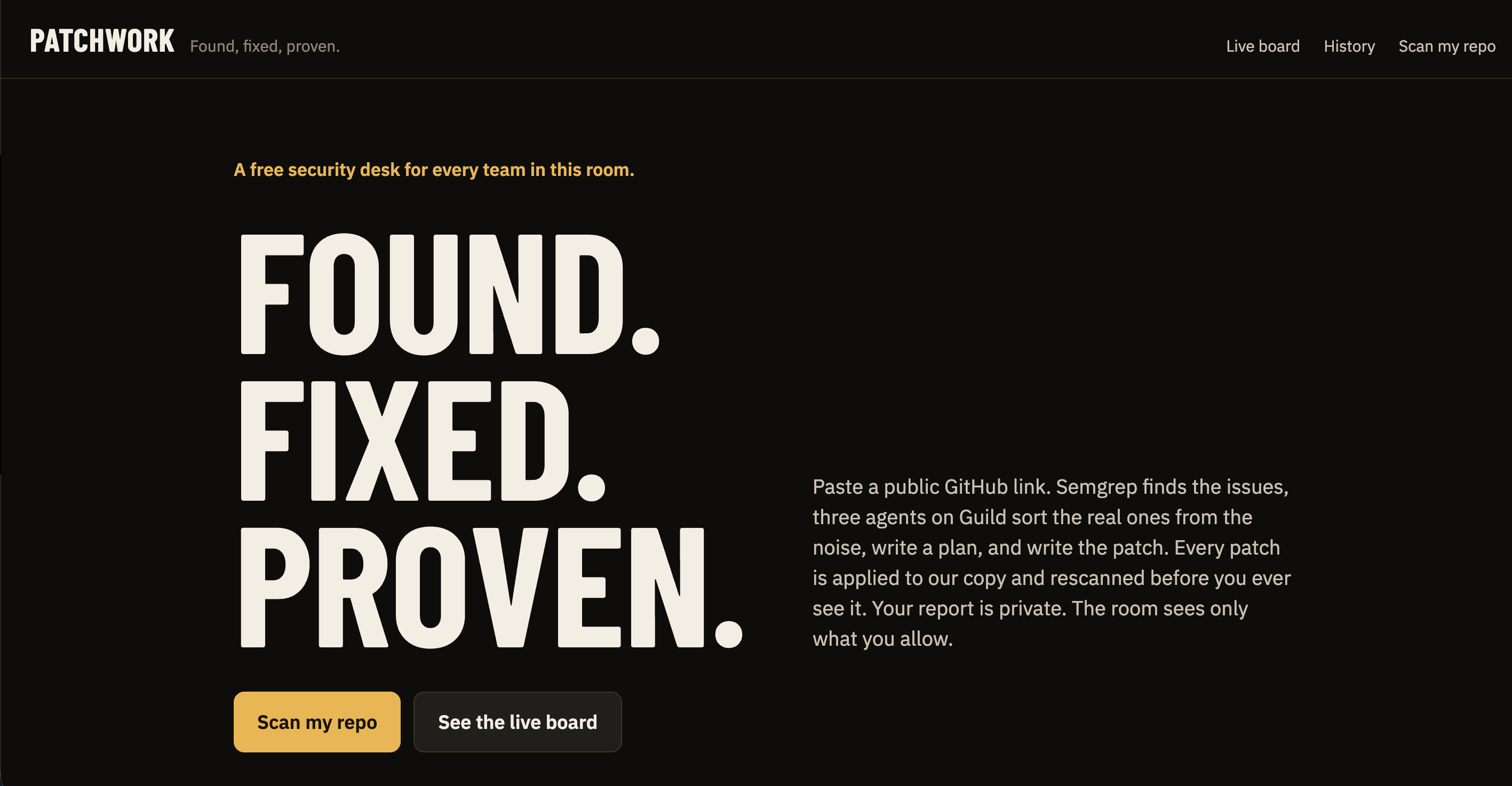
Every team at a hackathon ships AI-written code that nobody reviews. Patchwork is a free, opt-in security desk for the whole room. A team pastes a public GitHub link. We shallow-clone it and Semgrep scans every file. Three agents hosted on Guild do the thinking: a triage agent decides real issue or noise and explains why, a planner orders the fixes by root cause, and a fixer writes the smallest safe patch. Every patch is applied to our own copy, never the team's, then syntax-checked and rescanned with Semgrep. Only patches that pass are shown, as "verified by rescan", and each one can become its own pull request. Teams get a private report with a live stage tracker, a repo map, the fix plan, verified diffs, and one patch file. Guided mode lets a team run triage, plan, and fix one step at a time.
Two ideas make it a room tool: variant hunt shows when the same bug appears in several projects, and room memory feeds every proven fix to the fixer the next time that rule appears.
Semgrep finds every issue and proves every fix. Guild hosts and runs all three agents, with every result linked to its Guild session. ClickHouse Cloud stores every scan, finding, verdict, and fix, and powers the live board, variant hunt, and room memory in milliseconds. Akash hosts the app in one container. We never run cloned code and mask secrets before storing or sending anything.
Team
Mohammed Adnan · kaushik Sivakumar · Rifa Safeer Shah
 Guild.ai
 ClickHouse
 PiNo link provided
 Akash
 Semgrep