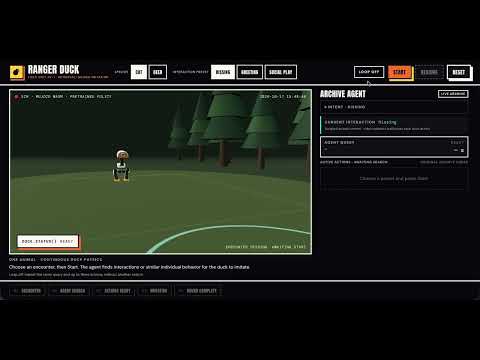
What We BuiltMicroDuck uses real-world animal videos to guide a simulated robot’s responses, combining video search, playback, agent-driven actions, and physics simulation. We ingested three Hugging Face datasets totaling X minutes of video.
Why It MattersRobot training needs diverse interaction data. MicroDuck explores using animal videos as behavioral references for embodied AI. Potential applications include long-term, close-range wildlife observation and pet companionship.
How It WorksEncounter Mode: Retrieve an interaction video, use one animal’s behavior as the situation and the other’s as a response reference, then execute MicroDuck’s closest supported action.Loop Mode: Turn each completed action into the next search prompt and repeat.The agent harness coordinates retrieval, interpretation, action selection, and execution feedback, using existing pretrained movement policies to explore future training workflows.
TechnologySimulation: Pollen Robotics’ MicroDuck simulator, MuJoCo WebAssembly physics, Three.js rendering, and ONNX Runtime Web movement policies.Agent and evaluation: Codex with MCP search tools; Weights & Biases for tracing and evaluation.Video infrastructure: VSS, VastDB, and S3 for searchable clips, captions, metadata, detections, and playback; VAST DataEngine with Cosmos3-Reason, YOLO11, and Cosmos Embed1 for descriptions, detections, and embeddings.Application: React and TypeScript frontend with a Python FastAPI backend.

 VAST Data
 CoreWeave (Weights & Biases)
 NVIDIA