tokens&
For enterprises
tokens&

Find tools, check provider offers, save a build plan, and share your work when you’re ready.

For buildersFor enterprises

For builders

  • Startup credits and perks
  • Agent Skills
  • Publish a project

For enterprises

  • Start free company workspace
  • Submit a tool, product, or perk

Community

  • Community
  • Newsletter
  • Events
Xin

© 2026 tokensand, LLC. All rights reserved.

  • Terms
  • Privacy
  • Security
  • Data Processing
  • Status
  1. Hackathon
  2. Project gallery
  3. ScopeWatch
Anonymous builderabout 2 hours agoJudging locked: Event build

ScopeWatch

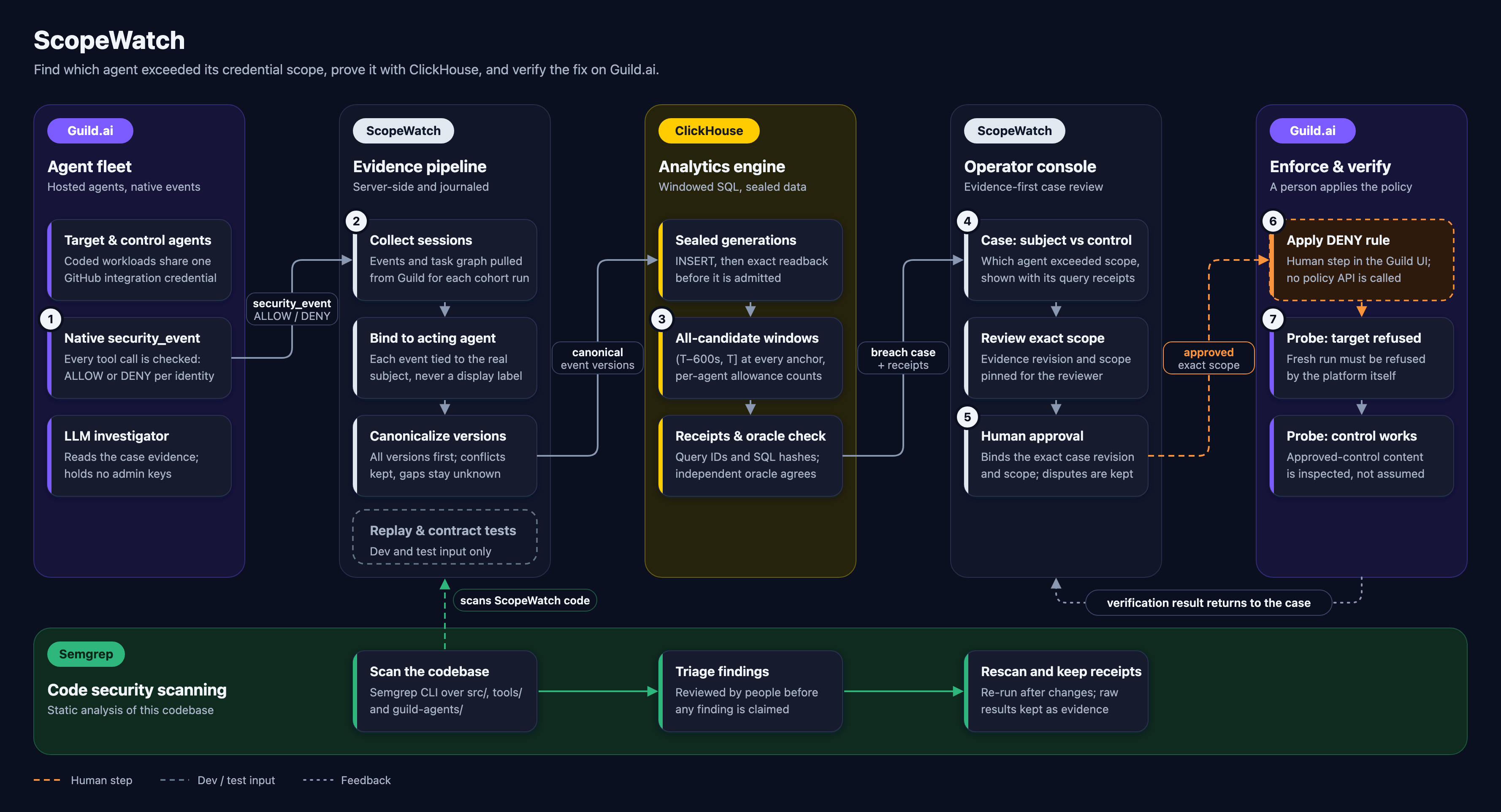
Find the one agent that overreached its own allowance, contain exactly that capability, and prove that approved agents keep working.

Review the project

Start with the source code, then open the demo or video if available.

View GitHub repository
Watch demo video
Demo video
Watch demo video
Project description
What we built: Least-privilege control for AI agent fleets. When several agents share one credential and one starts overusing a permission (say, after reading a manipulated ticket), ScopeWatch finds that exact agent, blocks only that capability, and proves the approved agents keep working.How it works: We collect every native permission decision and tie it to the agent that actually made it. Then we check each agent against its own allowance in a 10-minute sliding window at every past moment, not just now. An operator reviews the case, approves one exact scope and applies a DENY. Fresh probes must show the target refused and a busier approved agent still getting its expected result. Nothing auto-releases. Guild.ai: Hosts the fleet: two coded agents built with the agents SDK plus a read-only LLM investigator, launched through an API trigger. Every GitHub tool call emits a native ALLOW/DENY security_event, and we walk the task graph to attribute it. Containment is a DENY rule in Guild's credential policy.

Tools used
  • Guild.ai logoGuild.ai
  • ClickHouse logoClickHouse
  • SSemgrep
Project gallery
ClickHouse:
The decision is made in SQL. Parameterized queries evaluate every agent at every event anchor over (T−600s, T], with conflict-first dedup, exact readback before a case opens, and a receipt per query (query_id, SHA-256, latency). An independent oracle must agree. Runs locally and on ClickHouse Cloud.
Semgrep:
We scanned our own AI-assisted codebase with 165 rules (OWASP, secrets, SQLi, AI best practices): 0 findings.
Project links
  • GitHub repository
  • Demo video
Tools used
  • Guild.ai logoGuild.ai
  • ClickHouse logoClickHouse
  • SSemgrep