The problem
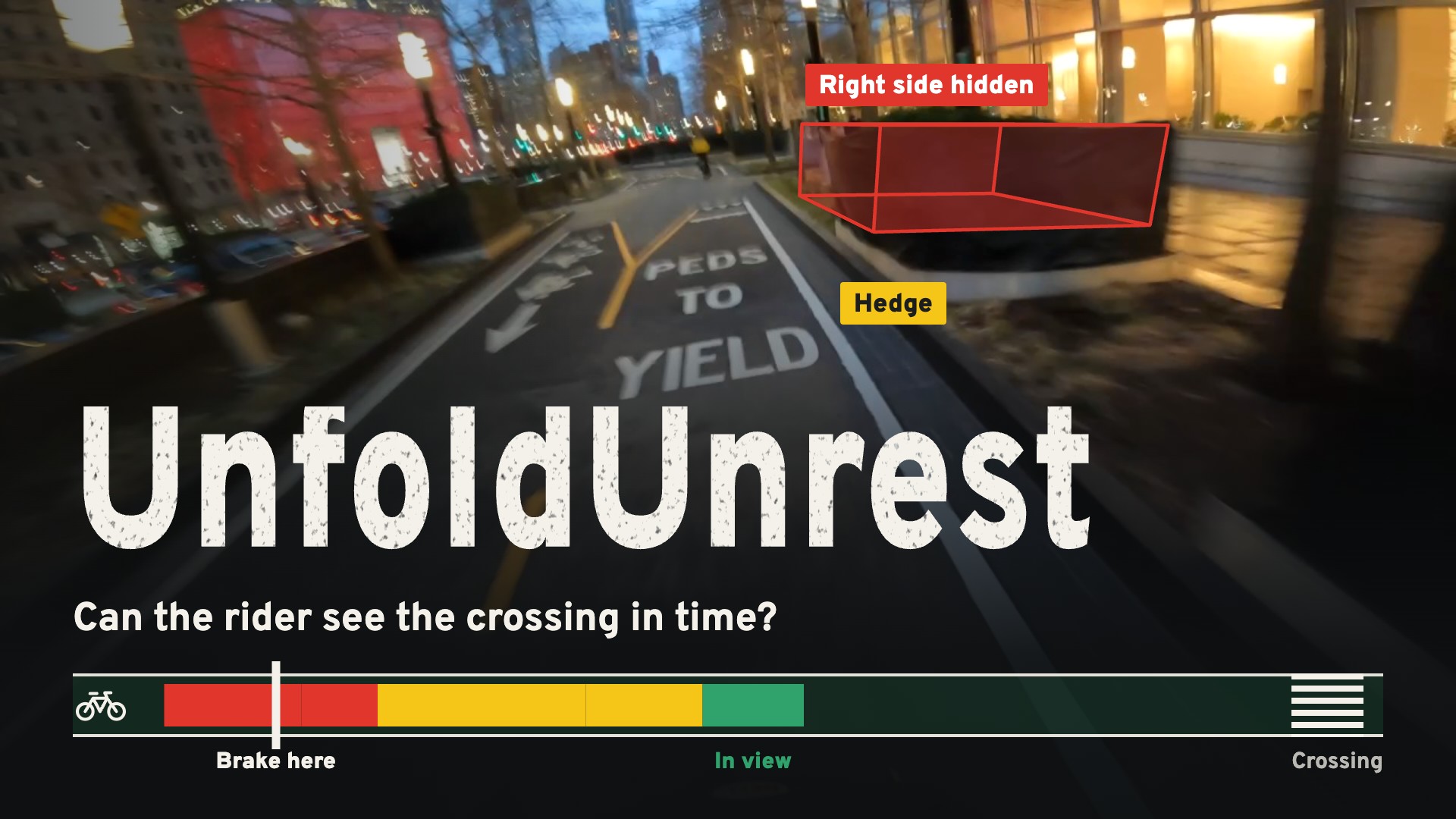
At a crossing, a person on a bike needs to see who is about to step out, early enough to stop. Hedges, planters, kiosks and parked cars set right up to the crossing take that view away. Cities fix this by daylighting, clearing the space before crossings, but finding the bad corners takes site visits and complaints, and those checks happen from a driver’s or walker’s eye, not the bike lane.
What it does
UnfoldUnrest turns ordinary first-person ride video into that audit. It rebuilds the street in 3D, finds the crossings and everything around them, and asks one question at each: could the rider see both sides in time? Where they couldn’t, it names what was in the way, suggests the fix, and shows the frames that prove it.
The value
Every ride becomes a survey. Planners get specific corners and objects to act on instead of a general call for safer streets. Advocates get evidence they can point to. Riders learn which crossings to slow down for. It needs only a camera, so it reaches any street people ride.
How the sponsor tools fitW&B Inference runs a vision model as an independent second opinion: the 3D check makes a claim, and the model looks at the real frames and confirms or rejects it, so whoever acts on a finding can trust it. Weave traces every stage, prompt, image and answer, so each finding can be followed back to its footage and reasoning. Clips arrive from the VAST environment carrying their source, so every result traces to the video it came from.

 SpaceXAI (Cursor)
 CoreWeave (Weights & Biases)
 NVIDIA