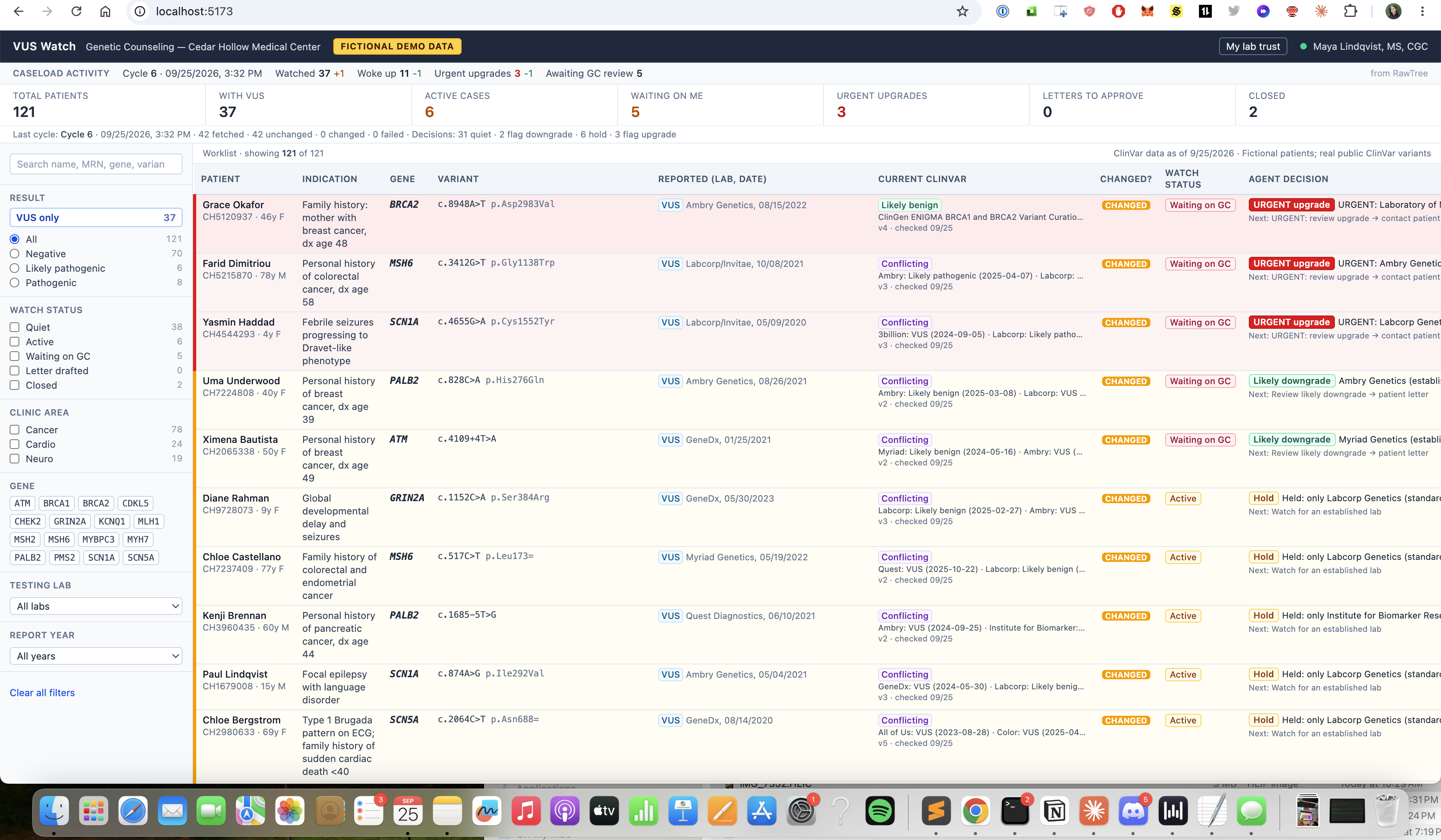
A woman's genetic test finds a change in BRCA2 that no one can yet call harmless or cancer-causing: a variant of uncertain significance (VUS). She's told "we'll let you know." Years later a lab decides it causes cancer. If no one tells her, she misses the screening that would catch it early, and her sisters never learn to get tested. If it turns out harmless, she's been worrying for nothing, and may have had surgery she didn't need.
Labs post these reclassifications to ClinVar, the public NIH database. Often, no one tells the counselor. No one can recheck thousands of patients' variants by hand, so the news sits there.
Vigil is the agent that keeps the promise "we'll let you know." Each cycle runs unattended:
1. Nimble fetches the live ClinVar page for every watched variant.
2. Liquid AI's LFM2.5 pulls out each lab's call, checked against the page text so a misread can't trigger a false alarm.
3. Vigil compares with the last cycle and acts: flag an urgent upgrade (now disease-causing) for the counselor, draft a letter for a downgrade (now harmless), or wait for stronger evidence. It follows the counselor's past decisions and which labs they trust.
4. Tinybird / RawTree logs every decision; the dashboard queries it with SQL.
5. Black Forest Labs FLUX.2 [pro] illustrates the good-news letter.
The counselor's time goes only to what needs a human: approving what reaches the patient. Demo: 6 cycles over 121 fictional patients with real ClinVar variants.