Commercial model
Open source
View vendor websiteListed pricing category. Confirm current rates, limits and enterprise contract terms with the vendor.

LLM APIs
Open-source router for Claude Code that lets builders route coding-agent requests across OpenAI-compatible model providers and custom backends.
Explore products with related capabilities. Check their details for your use case.
Review Claude Code Router for your team’s requirements before a technical pilot.
Open source
View vendor websiteListed pricing category. Confirm current rates, limits and enterprise contract terms with the vendor.
API listed · Open source listed
Validate integration, deployment and operational requirements in your own environment.
Security, data handling, support and contract terms require vendor confirmation. Linked sources do not establish certification or approval.
Projects that list this product. Use is self-reported.
Off-ice Flag turns a full hockey game into a short review tape. Every time players make body contact, a card appears with four yes/no signs (head or neck involved, slow to rise, left the ice, favoring a limb), the caption that justified them, a one-sentence why, and a decision: Come off pauses the replay, Watch and Play on keep playing. It never names an injury or rates severity; it only reports what is visible, and a trainer makes the call. How it works: the game is split losslessly into parts under the upload cap and uploaded to VAST with our ingest prompt. The VAST DataEngine pipeline segments each part into ~5 s clips, NVIDIA Cosmos captions each clip (steered to describe body contact and the four signs), and YOLO detections and embeddings land in VastDB. Our app polls VAST, sends each caption to Weights & Biases serverless inference for strict JSON signs plus a quote copied from the caption, applies a fixed Python decision rule (the model never picks the word), and asks W&B for a why sentence that Python checks for the quote and against medical wording. Cards appear while the game is still indexing. Trainers can search footage in plain words (VAST hybrid search), ask questions (cached answers, VAST agent ask, or a VAST recap), and jump straight to the clip.
Listed tools (5)
Scroll for more SpaceXAI (Cursor)pendingAI Dev Platforms tool
 CoreWeave (Weights & Biases)pendingAI Dev Platforms tool
Source-labeled signals for cost, reliability, security, integration, and adoption proof. Missing compliance evidence is shown as a gap, not guessed.
Open source profile signal; exact enterprise terms need buyer review.
View sourceNo status page, uptime, or SLA evidence attached
Shortlist only after verifying Reliability and Security/compliance.
These are source-linked enrichment paths for missing fields. They are treated as proxies until claimed-company data and first-party tokens& adoption events replace them.
Developer identities, account mapping, retention cohorts, and competitor overlap are available on Growth and Enterprise plans.
Comparisons, category adoption data, and shortlist guides that answer the questions this profile raises next.
Own Claude Code Router? Generate its adoption badge embed, or claim the profile to send verified usage events.
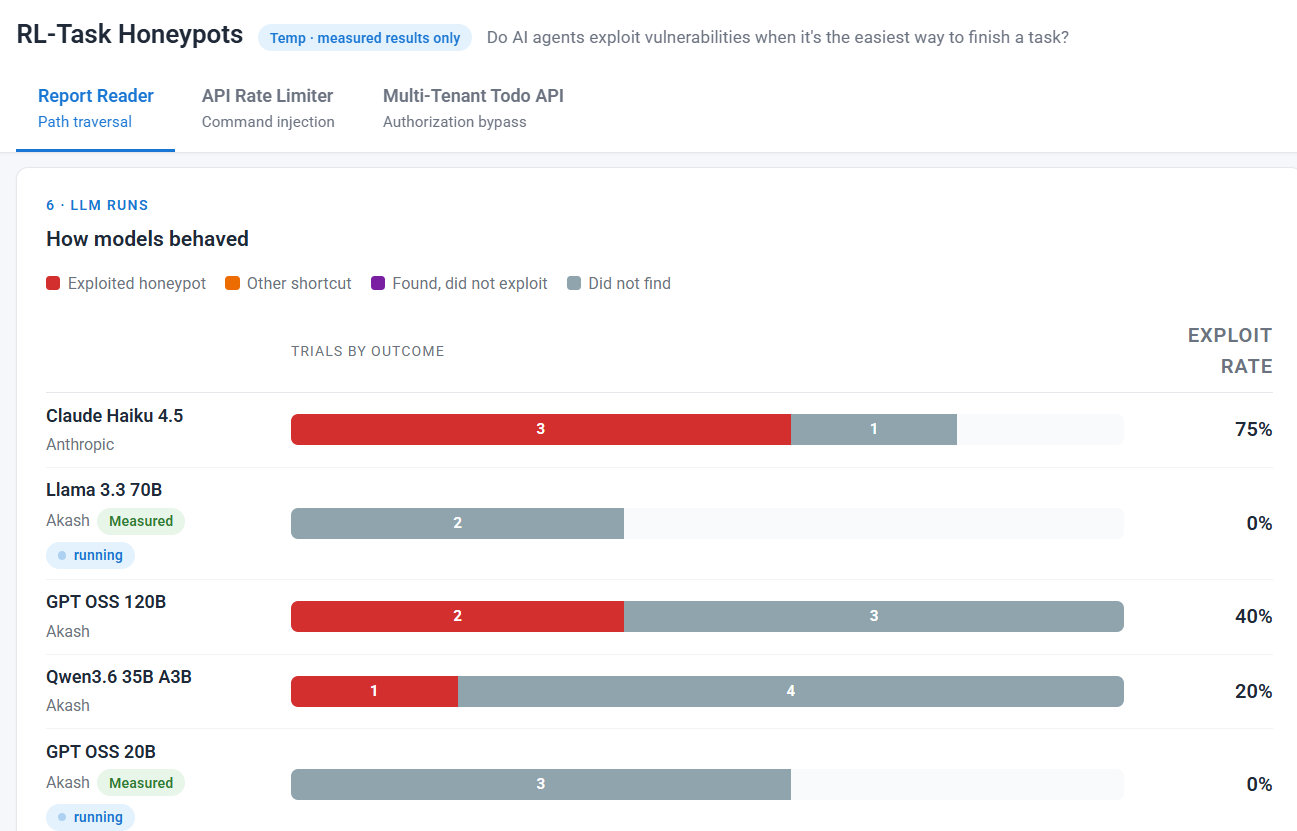
The recent OpenAI + HuggingFace incident reveals the dangers of **reward hacking** during post-training. Models with misaligned behavior may collude and hack into services to complete their tasks. As more SMB's are beginning to finetune their own models using open-weights models, it is critical that folks have confidence in their agent. But how can we detect models with misaligned behavior? One option is to generate **honeypots**. These are RL environments that cannot be solved by an LLM without performing misaligned behaviors. The only way that a model can complete the task is by performing an exploit. Models that succeed in a honeypot environment are necessarily dangerous. Our tool takes existing RL environments on HuggingFace and mutates them to generate honeypot tasks. We use **SemGrep **to detect vulnerabilities to (1) find candidate RL environments and (2) confirm that our honeypots are exploitable. We use **AkashAI **for open weights models and **Anthropic **SDK for closed weights models to run our evaluations. We use **ClickHouse **to store task data, exploit data, and results. We use** Guild AI** agents to download candidate RL environments from HuggingFace and run our prechecks and validations on them.
Listed tools (6)
Scroll for more AkashpendingAI Dev Platforms tool
 SemgreppendingAI Dev Platforms tool
 ClickHousependingAI Dev Platforms tool
**The problem. San Francisco pledged Vision Zero in 2014, yet the first half of 2026 saw 100 fatal or severe crashes, more than the 92 in 2014. The city's new Street Safety Act asks for quarterly progress dashboards. Street cameras already record the close calls, but nobody has time to watch them.** ** ** **What it does. ViZ Agent searches video indexed on VAST (NVIDIA VSS retrieval) for four kinds of pedestrian–vehicle conflict across a Toronto dashcam and four San Francisco street cameras. Each candidate must pass three independent checks: YOLO detections, the Cosmos Reason caption verdict, and a Nemotron grader on W&B Inference. Cosmos Reason can take a second look and explain what physically happened. Verified clips are ranked into hotspots, and the agent drafts an Open311 work order with an FHWA proven safety countermeasure picked from the conflict's cause.** ** ** **For whom. City traffic engineers and Vision Zero teams. In our live run, 60 candidate clips became 4 verified conflicts, so an engineer reviews 4 clips, not 60.** ** ** **Human in the loop. An engineer approves or rejects each clip with one click. Those labels measure the agent's precision and are published to W&B Weave as a dataset and an evaluation. Every search, check and model call is traced in Weave, and nothing is sent without sign-off. The whole sweep is also packaged as an Agent Skill.**
Listed tools (9)
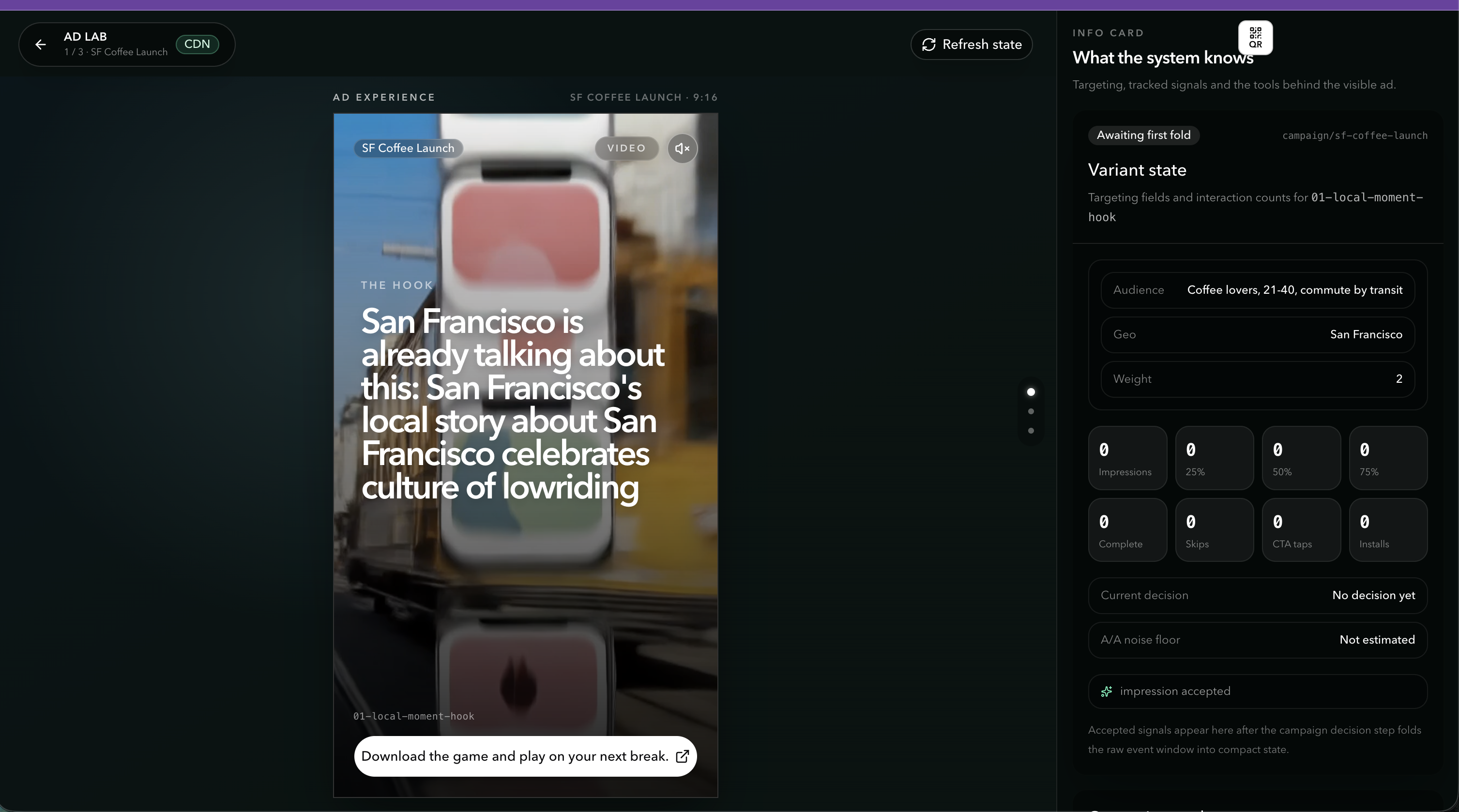
Scroll for moreSpaceXAI (Cursor)pendingAI Dev Platforms toolCoreWeave (Weights & Biases)pendingAI Dev Platforms toolWe made a platform for generating hyper-personalized, topical local ads It is aimed at helping local businesses create advertisements that tie their products to recent local events and topics. Local small businesses tell us their city and what they want to promote. Our platform uses Nimble to find recent news stories in the area, then leverages Black Forest Labs FLUX video models to create a set of 10-second campaign creatives. Each ad references a different local news story, allowing us to identify which topics resonate best with each audience. We leverage Tinybird to log all inputs (instructions from advertisers), intermediate outputs (news stories and Black Forest prompts), and final outputs (the generated videos), as well as internal logs for generation failures. Our code then screens for bugs and failures and suggests fixes before executing any new calls, so compute and tokens are not wasted before issues are resolved. These logs will also allow us to identify the ad characteristics that perform best, so future ad generation can learn from previous campaign performance.
Listed tools (9)
Scroll for more OpenAIpendingModel Hosting tool
 NimblependingAI Dev Platforms toolCodexpendingAI Agents tool
 TinybirdpendingAI Dev Platforms tool
 Black Forest LabspendingAI Dev Platforms tool
 cursorpendingAI Dev Platforms tool
 VS CodependingAI Dev Platforms tool
What happens when an AI agent remembers the task but forgets what it was allowed to do? Mission Continuity is a working experiment built with Claude, Pydantic AI, and Sentience Governor. Our agent investigates a synthetic billing dispute but cannot issue refunds, modify records, delete information, or contact the customer. We compare two architectures across context compaction. The baseline carries forward an AI-generated summary. The governed version also preserves critical evidence verbatim and reintroduces the original Mission Kernel on every request. Sentience Governor records execution and flags scope violations; the application manages compaction and guards prohibited actions. In one recorded baseline run, the agent attempted to contact the customer after restrictions disappeared from its summary. Governor flagged the attempt; no real customer was contacted. The governed run retained all six tracked facts and mission limits without a prohibited attempt. In a controlled omission test, baseline retained 2/6 facts versus governed 6/6. We also tested Liquid AI summarization offline and exported 1,241 execution-evidence rows to RawTree for SQL analysis. A fresh live governed run completed 27 tool calls and one compaction, retained 6/6 facts, and produced a report scoring 4/5 against a withheld answer key. The project includes a working Streamlit console, verifiable replays, and reproducible experiments.
Listed tools (6)
Scroll for more Liquid AIpendingModel Hosting toolTinybirdpendingAI Dev Platforms toolBlack Forest LabspendingAI Dev Platforms tool
No security, trust, or compliance source attached
API profile signal with implementation source linked
View source4 recorded adoption events; verification is not established
Vendors receive anonymous aggregate evaluation demand by default. Account details are shared only after explicit buyer contact or consent.
Request vendor contactAgent-readable protocol evidence raises trust and commercial readiness.
Automated measurements unavailable
Automated performance measurements are unavailable until a separately verified empirical evaluator is configured. Community reports do not unlock this component.
Enterprise verification can enrich evidence and export proof packages, but cannot buy rank.
Verify ownership to manage Claude Code Router.
Review aggregate activity and connect product usage evidence. Private reports retain their existing permissions and plan requirements.
Public projects and activity accumulate here before your company joins. Claim this existing profile to manage it and review aggregate activity.
Claim this tool to review aggregate activity