Evidence
First-party technical activity
Bring permitted program, docs, product-usage, project, and integration events into a readout that retains source and measurement context.

Preparing tokens&
Loading the next builder or enterprise surface.
LoadingPreparing page
Loading product graph, proof, and adoption context.
LoadingDeveloper activity can indicate evaluation or adoption, but activity alone is not proof of purchase intent. tokens& combines source-labeled program context, customer-provided product events, and permitted account matches in one readout so GTM teams can qualify the evidence before acting.
Best fit
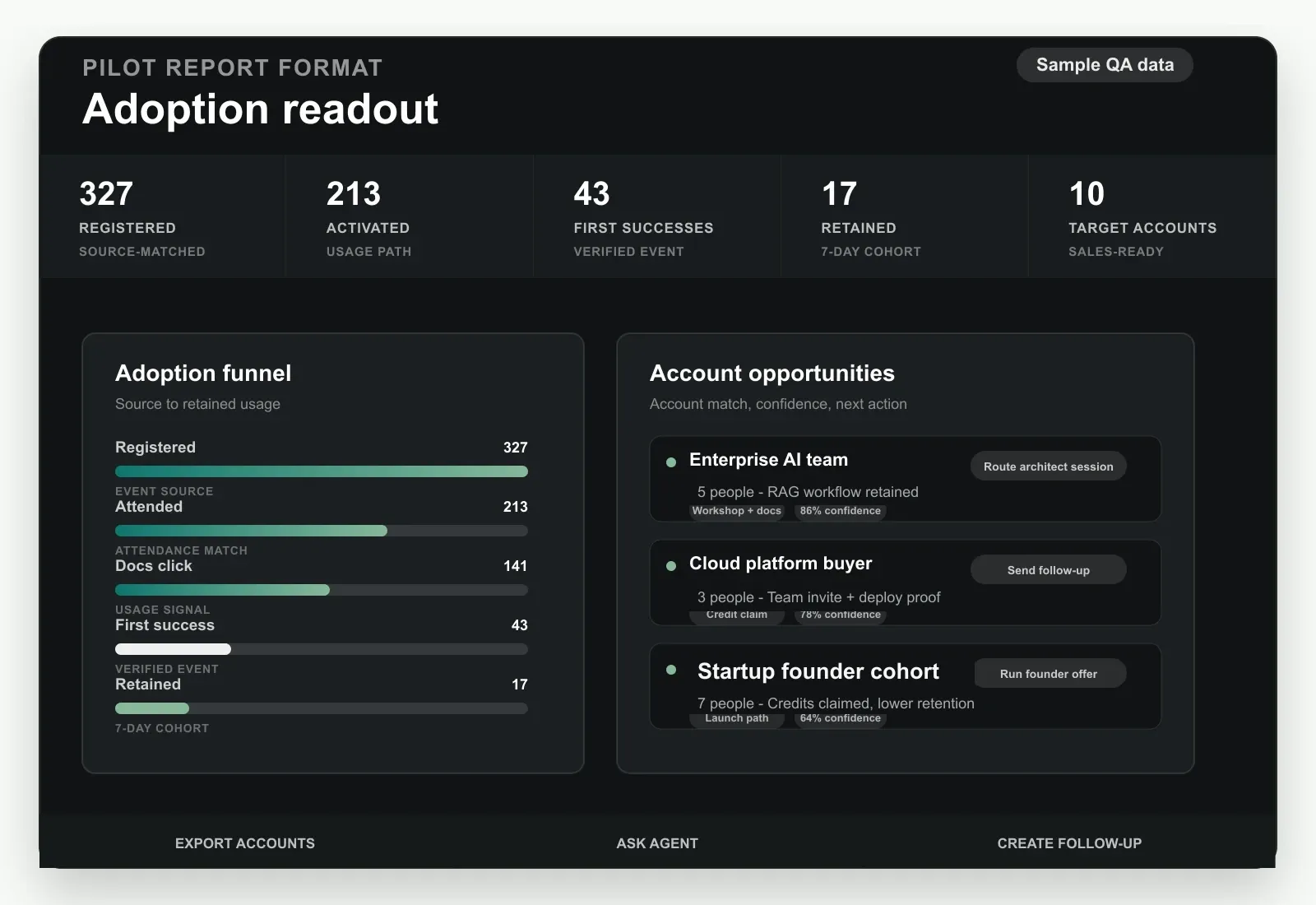
Use tokens& when the decision depends on connecting a source-labeled developer motion to product adoption, account evidence, and an assigned next action. Keep event operations, in-product analysis, and CRM execution in the systems that already own them.
Bring permitted program, docs, product-usage, project, and integration events into a readout that retains source and measurement context.
Evaluate repeated usage, product fit, project proof, and approved company matches before treating a developer signal as an account priority.
Record the evidence class, confidence, permitted use, owner, and next action so a recommendation can be reviewed instead of accepted as a black-box score.
Workflow
Define the source, activation event, evidence classes, and decision before the program runs. Then compare observed usage with the agreed baseline and record the next action.
Choose the technical behavior, activation threshold, account criteria, and decision the signal is expected to support.
Add source-labeled program context and customer-approved docs, product, project, or account inputs without exposing raw private identity publicly.
Separate an observed action from an account match or modeled inference, then inspect repetition, product fit, blockers, and confidence.
Assign an owner and a permitted next step such as product support, nurture, account follow-up, or no action.
Buyer decision guide
Treat intent as a reviewable evidence chain. Define the behavior and window first, preserve source and permission, then require stronger adoption and account context before assigning a commercial action.
A defined technical behavior, source, time window, and repeated or deeper product activity.
One docs visit, download, repository star, or event registration.
A permitted account match plus product fit, repeated adoption evidence, confidence, and an agreed use.
An identity or domain match without product and permission context.
An evidence class, owner, permitted use, supporting source, and explicit next step.
An unexplained score or modeled recommendation presented as observed intent.
Category comparison
These categories can be useful. tokens& covers the developer program attribution layer between the external technical motion, product adoption evidence, and the governed account action.
Reo.dev — developer intent
You need a system specialized in detecting developer activity across technical surfaces and prioritizing accounts from those signals.
tokens& can place customer-approved intent signals beside source-labeled program and product-adoption evidence in a governed decision readout.
Common Room — community and revenue intelligence
You need contact and organization signal unification across product, CRM, social, and community sources with GTM workflows.
tokens& focuses its readout on measured developer adoption, evidence provenance, program attribution, and the recorded next decision.
Scarf — open-source usage intelligence
You need open-source package and documentation usage signals that help identify organizational adoption.
tokens& can treat approved OSS usage as one evidence class alongside program, product, project, and account context.
Evidence labels
Every buyer readout should show where a claim came from. Public context, customer-provided events, matched account context, and modeled assumptions remain distinct so forecasts are not presented as realized value.
FAQ
Developer intent data is technical activity that may indicate evaluation, adoption, or expansion. Useful examples include repeated docs or SDK activity, product activation, integration work, project proof, and source-labeled program engagement.
No. A technical action is evidence, not a purchase decision. tokens& keeps observed activity, permitted account matches, and modeled interpretations separate so the team can qualify a signal before acting.
No. Reo.dev, Common Room, Scarf, product analytics, and CRM systems can remain specialist or operational sources. tokens& connects approved evidence to a source-labeled adoption and decision readout.
Connect developer programs, adoption evidence, account context, and governed handoffs across teams.
Measure activation, retained usage, blockers, and account evidence across sources.
Tie one defined developer program to observed adoption and an assigned next action.
Publish products, Agent Skills, and perks for free. When private attribution, account intelligence, exports, or governed actions are needed, sales provisions paid enterprise access manually after agreement—there is no pricing page or self-checkout.